How to Open a Children’s Clothing Store?
Opening a children’s clothing store isn’t just tiny outfits—it’s taming tiny shoppers, pleasing tired parents, and surviving juice-stain chaos. It’s part retail magic, part playground diplomacy. Get the space right, and “I don’t want to shop!” becomes “Can we stay forever?” Let’s see how to pull that off.
1.Core Layout Principles for Spatial Design
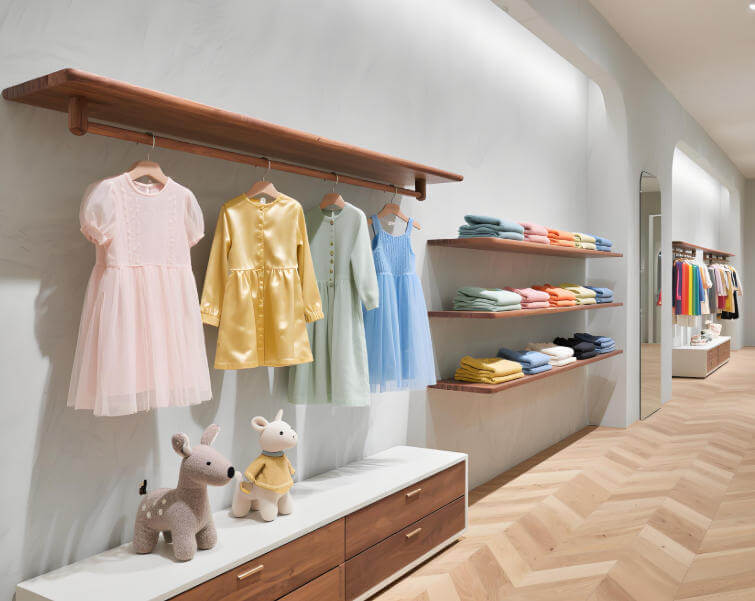
Spatial design forms the operational foundation of a children’s clothing store, requiring strategic zoning of three functional areas to balance shopping convenience, safety, and parental comfort.
The Children’s Play Zone should be positioned at the storefront visual focal point, occupying 15%-20% of the total area. This zone acts as a natural attraction for young customers, reducing their resistance to shopping. It must feature eco-friendly soft flooring with a thickness of at least 3cm—preferably made of non-toxic EVA foam that meets EU EN 71 safety standards—to cushion potential falls.
All edges and corners in this area need radius-edge protection to eliminate sharp contact points. Educational building block walls with large, lightweight pieces (to avoid choking hazards) and mini bookshelves stocked with picture books can keep children engaged. Color psychology plays a key role here: vivid yellows and sky blues are used to stimulate curiosity and exploration, while ensuring clear parental sightlines from adjacent rest areas so caregivers can monitor their children without constant movement.
The Parent Lounge, located mid-store against walls and taking up approximately 10% of the area, serves as a relaxation hub for accompanying adults. It should include 2-3 sofa sets with a depth of 60-80cm—chosen to accommodate parents of different body types comfortably—each equipped with USB ports (at least two per sofa) for charging mobile devices.
A dedicated stroller parking area with clear signage prevents congestion, while semi-transparent acrylic partitions maintain visibility of both the play zone and shopping areas while offering a degree of privacy. Parenting magazines, seasonal catalogs, and even small refreshment stations (with sealed water bottles or packaged snacks) can further reduce wait-time anxiety, encouraging parents to spend more time in the store.
The Smart Storage Zone, placed at the back of the store and accounting for 8%-12% of the total area, ensures efficient inventory management. It implements heavy-duty racking with a maximum height of 2.2m (to allow easy access without ladders) and barcode labeling on every shelf for quick stock checks. Aisles between racks must be at least 90cm wide to accommodate staff carts and facilitate smooth restocking.
Environmental sensors are critical here, maintaining a temperature of 18-22°C and humidity of 40-60% to protect delicate fabrics from mold or shrinkage. Additionally, reserving 20% buffer space within this zone prevents overcrowding during peak seasons like holidays or back-to-school periods, ensuring operational efficiency.
2.Dual Innovation Strategies for Display Fixtures
2.1 Safety-Centric Customization System
Precision scaling of fixtures is essential to cater to children’s physical characteristics. Garment rods with a diameter of 22-25mm (compared to the adult standard of 30mm) are easier for small hands to grasp, while shelf depths of 30-35cm prevent excessive stacking that could cause items to topple. Height zoning is equally important: the infant section is set at 80-110cm (within easy reach of adults carrying babies), and the school-age zone at 110-150cm (aligned with the eye level of 6-12-year-olds).
Reinforced safety measures are non-negotiable. Freestanding display islands require L-bracket anchoring to the floor, with load tests ensuring they can bear at least 50kg without tipping—critical for preventing accidents if children climb on them. All metal components undergo triple polishing to achieve a roughness of Ra≤0.8μm, eliminating burrs that could snag clothing or scratch skin. Wood elements must meet E1 formaldehyde standards (emissions ≤0.124mg/m³) to avoid harmful chemical exposure, and every edge, from shelf corners to hanger hooks, features a radius of at least 5mm.
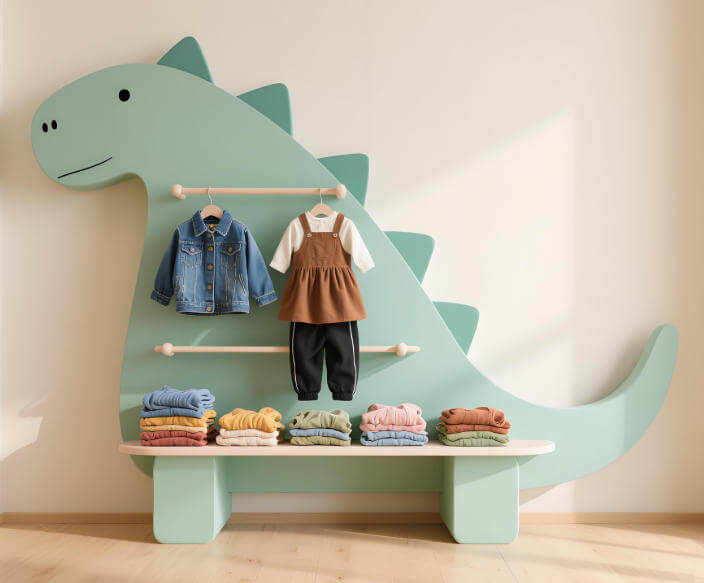
Age-specific zoning enhances both safety and shopping experience. Newborn sections use cloud-shaped padded displays to cradle delicate items like onesies and swaddles; toddler zones incorporate animal-ear hooks (in shapes like rabbit ears or bear paws) to make clothing selection feel playful; older children’s areas feature modular sport racks with adjustable heights to accommodate varying sizes of jackets, pants, and activewear.
2.2 Immersive Display Solutions
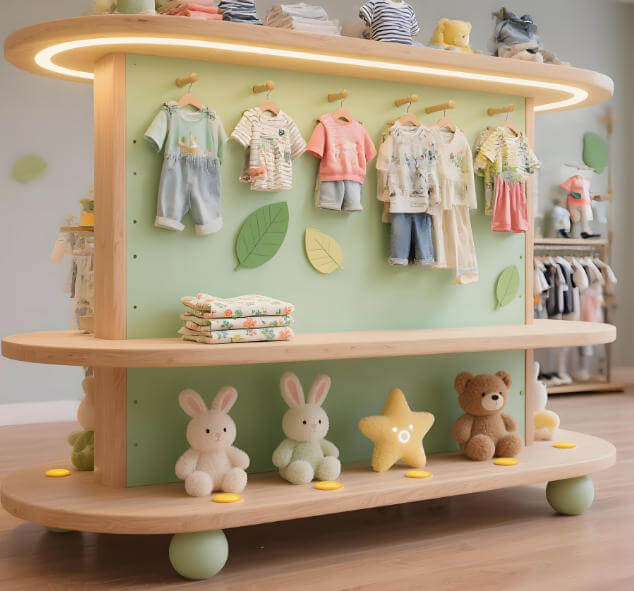
Thematic islands create seasonal excitement and encourage exploration. Magnetic-back panels allow easy theme changes—for example, forest themes with leaf-shaped magnets in spring, or space themes with star and planet decals in autumn. Integrated 2700K LED strips behind these panels cast a warm, inviting glow, while pressure-sensitive plush toy stations (placed at the base of islands) trigger sound effects (like animal calls or space sounds) when touched, increasing interaction.
Smart technology elevates the shopping experience significantly. 4K virtual fitting mirrors with gesture recognition let children “try on” clothes in 3 seconds by waving their hands, displaying how outfits look from different angles without physical changing. AR interactive rugs (1.5×2m) placed in central areas project animated clothing displays—when children step on specific spots, digital versions of outfits “appear” on their bodies, making the process engaging and reducing fitting room queues.
Contextual displays help parents visualize clothing in real-life scenarios. Life-size setups like classroom scenes (with small desks and chairs) or birthday party backdrops use lightweight, removable PP hollow-board props to showcase appropriate outfits. Zone-specific lighting enhances these contexts: 4000K neutral light in reading corners highlights comfortable loungewear, while dynamic RGB lighting in party areas makes festive clothing stand out.
3.Strategic Material Selection by Tier
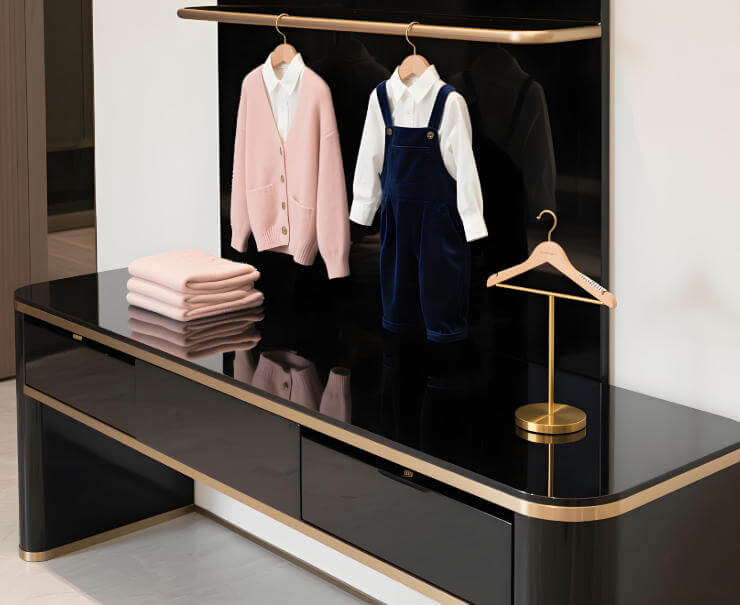
Premium Stores (Price Point ≥USD70) prioritize durability, aesthetics, and safety. Metal fixtures use 304 stainless steel with a brushed finish (1.2-1.5mm thick) and PVD anti-fingerprint coating to resist corrosion and maintain a sleek look. Wood components are made from E0 MDF (formaldehyde emissions ≤0.05mg/m³) with either piano lacquer for a high-gloss finish or 0.6mm walnut veneer for a natural texture. Hardware includes Hettich soft-close hinges (tested for 200,000+ cycles) and Blum undermount slides, ensuring silent, smooth operation that won’t startle children.
Mid-Tier Stores (USD30-70) balance quality and affordability. Metal structures use cold-rolled steel tubes (at least 1.0mm thick) with epoxy powder coating, which offers good scratch resistance and comes in a variety of colors to match store themes. Wood elements consist of melamine-faced particleboard (density ≥650kg/m³) for stability, with 2.0mm PVC edging to prevent chipping. Hardware features DTC soft-close hinges paired with aluminum side-mount rails, providing reliable performance at a moderate cost.
Value Stores (≤USD30) focus on cost-effectiveness without compromising basic safety. Metal fixtures use Q235 carbon steel with basic powder coating to prevent rust, while wood components are E1-compliant laminate particleboard with mechanical PVC edging for durability. Hardware relies on zinc alloy fittings, which offer sufficient strength for light to medium use.
4.Sustainability Integration
Circular materials design extends fixture lifespan and reduces waste. Bolt-assembled fixtures ensure 80% of components (like shelves, rods, and panels) can be replaced individually if damaged, rather than replacing entire units. Material Passports—digital records tracking each component’s origin, material type, and recyclability—facilitate proper recycling at the end of the fixture’s life.
Energy optimization lowers operational costs and environmental impact. Solar-film integrated lightboxes (with efficiency ≥15%) power window displays using renewable energy, while motion-activated sensors on island fixtures automatically reduce power consumption when areas are unoccupied for 5+ minutes.
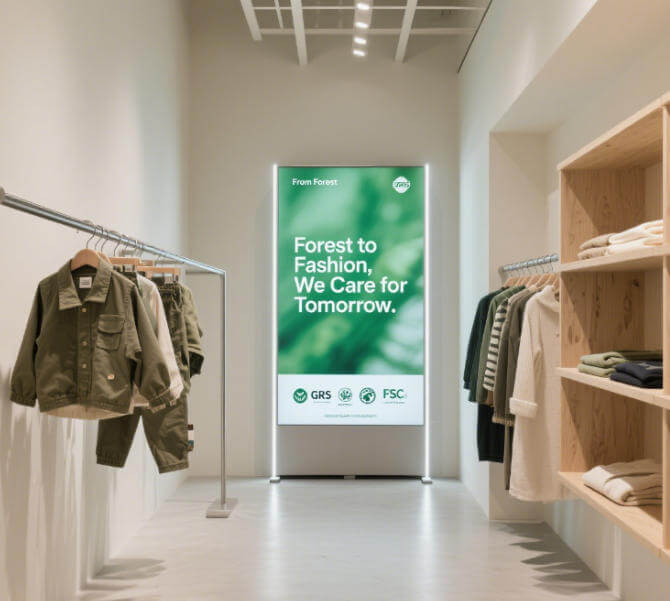
Certifications build brand trust by validating sustainability claims. Stores should use FSC-certified timber (ensuring responsible forestry). Displaying these eco-labels prominently—on fixtures or near checkout areas—educates customers about the brand’s commitment to sustainability, enhancing loyalty among environmentally conscious parents.